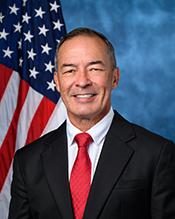
James C. Moylan
Federal · Guam
25%
RoR Score
0
Profile Views
Voting record only
Unclaimed profile
James C. Moylan has not joined Reviving Our Republic. This page is a public record compiled from Congress.gov and public sources — it is not written or endorsed by them, and nothing here represents their views. They have not responded to the 95 Theses, so they have no positions score; the score above is drawn entirely from their recorded votes, which are public fact.
Are you James C. Moylan, or on their staff? Get in touch and we will verify and hand it over.
Office
- Jurisdiction
- Federal
- District / Area Served
- Guam
Voting Record (24)
Federal votes sourced from Congress.gov.
- YeaAmendment prohibits the use of automated speed enforcement cameras on military installations.Jul 2026
HAMDT Amendment 261 · On Agreeing to the Amendment · Agreed to · Roll Call 275
Not related to the Republic's revival — not scored
This amendment to the FY2027 NDAA prohibits automated speed enforcement cameras on military installations. It is a narrowly scoped regulatory/safety measure concerning traffic enforcement technology on federal military property, and does not bear on any of the 40 policy theses, which address campaign finance, term limits, war powers, federalism, taxation, antitrust, official conflicts of interest, and related structural governance matters.
- Yea
HAMDT Amendment 258 · On Agreeing to the Amendment · Agreed to · Roll Call 273
Not related to the Republic's revival — not scored
This amendment to the FY2027 NDAA codifies legal protections and responsibilities for military chaplains and makes violations of those protections subject to prosecution under the Uniform Code of Military Justice. This is a military personnel and religious accommodation matter that does not touch any of the 40 policy theses, which address campaign finance, term limits, war powers, federalism, taxation, antitrust, and officials' conflicts of interest.
- Nay
HAMDT Amendment 266 · On Agreeing to the Amendment · Failed · Roll Call 276
Not related to the Republic's revival — not scored
This amendment would require the Secretary of Defense to report on options for reducing the DoD civilian workforce by 200,000 employees. While it touches on federal spending and government size, it is a workforce management and defense administration question that does not engage any of the 40 theses, which address structural matters such as campaign finance, term limits, war powers, federalism, taxation, antitrust, and officials' conflicts of interest — not the sizing of executive-branch agency workforces.
- Yea
HAMDT Amendment 259 · On Agreeing to the Amendment · Failed · Roll Call 274
Voted against the Republic's revival · measure rated -55
This amendment to the FY2027 NDAA would allow the Secretary of War (Defense) to approve an unlimited number of qualified private investors and cleared investment professionals to assess investment opportunities aligned with Defense Department requirements — effectively embedding private, profit-driven investors into the military procurement and planning process with no cap on participation. This cuts against Thesis 65, which holds that foreign and national security policy initiatives must never be determined by profit-driven corporations, and raises concerns under Thesis 95, which prohibits officials in regulatory positions from holding investments in corporations they oversee. By institutionalizing and expanding the role of private capital in identifying and shaping Defense Department investment needs — with no numerical limit — the amendment structurally deepens the entanglement between profit-driven financial interests and military policy.
- Yea
HAMDT Amendment 249 · On Agreeing to the Amendment · Failed · Roll Call 261
Voted against the Republic's revival · measure rated -55
This amendment to the FY2027 NDAA would direct a study into how federal authority could preempt or override state fuel and refining policies deemed to undermine national defense. While framed as a transparency and study measure, its explicit purpose is to identify mechanisms for federal preemption of state regulatory decisions — directly cutting against the theses' strong federalist principle that states are the government closest to the people and should hold primary regulatory and policy authority, and that services and governance should flow from the state level rather than being overridden by federal intervention.
Voting Score
Each measure in this record is rated against the book’s 40 policy theses, from −100 (undermines them) to +100 (advances them). A vote counts as aligned when it fell on the side that rating points to — a Yea on a measure that advances the theses, a Nay on one that undermines them — and each vote is weighted by how strongly the measure rates.
3 of 11 scored votes aligned · 13 of 24 left out: 13 on measures unrelated to the framework.
Procedural votes are excluded — on a motion to recommit or to table, a Yea is a manoeuvre, not a position. So are measures that never touch these 40 theses, which is a great deal of what any chamber votes on, and measures whose substance we could not establish from the public record: an unrateable vote is reported as unrateable rather than counted as a zero. Votes not cast are excluded too — an abstention is not a stance, and grading it as one would put words in a representative’s mouth. Ratings are an argument, not a verdict, and the full record is above so you can weigh it yourself.