✦
✦
Mike Bedenbaugh
Organized around the four dangers Washington identified in his Farewell Address. Search by keyword or filter by part.
Preamble
Out of love for Country and Liberty, and from a belief that both must be actively defended, these propositions and policy initiatives are offered for discussion and debate in our town halls, county seats, state capitals, and in the halls of Congress. Their purpose is to confront the excesses of political and corporate power and to consider practical reforms that can strengthen and preserve our Republic.
The theses posted here are intended to temper the fury of party spirit, warn against the dangers of foreign intrigue, expose the misuse of patriotism, challenge unchecked corporate power, and offer structural reforms capable of restraining these forces. Their ultimate purpose is simple: to protect individual liberty, restore meaningful self-government, and return greater power and responsibility to We the People.
The United States of America was created by citizens of many cultures and religious creeds whose leadership was elected to ensure self-governance for the people.
2Self-governance requires a legitimate basis for the creation of laws that protect the rights of an independent citizenry. REVIVING OUR REPUBLIC 6
3The United States required a framework of governance for the establishment of legitimacy in its laws.
4The citizens who created that original framework of our government should be considered architects who constructed a foundation on which to build a new legitimate system of governance.
5The citizen architects of our system of governance constructed the foundational principles to house the aspirations of many people under one roof in order to create one nation.
6The architects of this nation were the most politically knowledgeable men of their day, but with social perspectives limited to their time and place.
7The architects of this nation, understanding moral fallibility is inherent in humans seeking power, created a structure of checks and balances to limit the inevitable damage that can occur when centralized power to alter that structure is left unchecked.
8The architects of this nation, understanding the limitations in their own social perspectives, created a structure that can be renovated (amended) by the citizens within a prescribed rule of law. 7 PREAMBLE
9The chief architect and first president of this governmental structure, George Washington, delivered to the people of this nation an owner’s manual, or guide, in the form of a farewell address on how future generations could best maintain the structure.
10Our first president’s guide to governance warns of the dangers to our government structure that were recognized in 18th-century America if parasitic influences and neglect of duty are left unchecked and unchallenged.
11Since the publication of the owner’s manual 227 years ago, generations have grown numb to the potential dangers of these pitfalls.
12Our cumulative lack of disciplined diligence to our owner’s manual has created a governmental structure that has been undermined by the cumulative and generational laziness of citizens who have allowed an opportunistic and parasitic politicized leadership who gain prominence and power through discord and division.
13The primary points of Washington’s owner’s manual can be divided into four themes: • Moderating the fury of party spirit • Warning against the mischiefs of foreign intrigue • Guarding against the impostures of pretended patriotism • Maintaining fiscal responsibility Part I Washington’s Reflections on Party Spirit and Feigned Patriotism Patriotism means to stand by the country. It does not mean to
This spirit of party is inseparable from our nature, but, in those governments of the popular form, it is truly their worst enemy. REVIVING OUR REPUBLIC 10
15The alternate domination of one faction over another, sharpened by the spirit of revenge, is a frightful despotism. George Washington’s warning about the dangers of partisan politics and the spirit of revenge is reflected in numerous historical examples around the world where factionalism and party spirit have undermined the functioning of popular governments. Here are some notable instances: Anci
16The disorders and miseries which result gradually incline the minds of men to seek security and repose in the power of an individual.
17Sooner or later the chief of some prevailing faction…turns this disposition to the purposes of their own elevation. George Washington’s observations on governance were informed by his extensive knowledge of history, especially the example of the Roman Republic’s transformation into a tyrannical empire. Additionally, the English Civil War, which had occurred in the relatively recent century before
18The spirit of passionate factionalism always serves to distract the public councils and enfeeble the public administration.
19Factionalism agitates the citizenry with ill-founded jealousy and false alarms. The quote about the dangers of passionate factionalism highlights how intense political divisions can distract government decision-making, weaken administration, and create public unrest through unfounded fears and misinformation. Here are examples from American history illustrating these points: The Red Scare of the 1
20Factionalism kindles the animosity of one group against another in ways that can occasionally foment riot and insurrection. The New York Draft Riots (1863) Context: During the Civil War, the Union instituted a draft to bolster its forces, allowing wealthier men to pay for substitutes to take their place. This policy incited outrage among the working class, particularly Irish immigrants. Factionali
21The spirit of encroachment [that] tends to consolidate the powers of all departments in one, and thus creating a real despotism. The U.S. federal government has, at various times, consolidated power into bureaucratic departments in response to crises, perceived threats, and public fears. This process often centralizes authority and expands executive control, sometimes at the expense of civil liber
A candidate for political office can only accept campaign funds from individual citizens qualified to vote for them. In the realm of political governance, the integrity of the electoral process stands as the cornerstone of democracy. It is imperative that those seeking public office remain beholden to the interests of their constituents, rather than being swayed by the influence of special interes
23A candidate for political office should be limited to how many years they can serve to ensure the public benefit is not compromised by the power accumulated for their self-benefit. Throughout the annals of history, civilizations have grappled with the challenge of balancing stability with the need for periodic renewal in leadership. Ancient Athens provides a compelling example, where the rotation
24The source of income received by political candidates or office holders must be fully disclosed. The imperative of ensuring full disclosure of income by political candidates and officeholders cannot be overstated, as it lies at the heart of maintaining the integrity and accountability of democratic governance. Throughout history, clandestine financial dealings and undisclosed sources of income hav
25Elected members of Congress must not partake in a retirement plan. They should receive Social Security like the rest of us. Ensuring that elected members of Congress are not enrolled in a separate retirement plan but rather rely on Social Security, like the rest of the citizenry, is a crucial step toward promoting fairness, accountability, and empathy in governance. Throughout history, examples ab
26End the practice of dividing the congressional chambers along party lines and have all state delegations sitting together in both legislative houses. Ending the practice of dividing the congressional chambers along party lines and instead having all state delegations sit together in both legislative houses is a crucial step toward fostering unity, bipartisanship, and effective governance. Througho
27If the Senate maintains a filibuster rule, then the actual filibuster must take place and must adhere to the subject of legislation under debate. The filibuster, initially designed to safeguard minority interests and encourage robust debate, has undergone a significant transformation over time. Originally, filibusters required senators to engage in lengthy speeches to stall or block legislation, s
28End the practice of omnibus bills: any bill must pertain to one subject only, and that subject should be in the title. The proliferation of omnibus bills, encompassing multiple disparate provisions within a single legislative package, undermines the fundamental principles of transparency and accountability in the legislative process. This practice often leads to opaque decision-making, as lawmaker
29The Electoral College should not be party appointees nor winner-take-all. The Electoral College, as it stands today, has been a cornerstone of American presidential elections since the founding of the nation. However, its partisan nature and the winner-take-all system employed by most states have led to various criticisms and calls for reform. Transitioning to a nonpartisan and proportional system
30The Senate and the House must return to their original role of checks and balances with each other.
31For the Senate and House to check each other, the legislative branches must have different constituencies.
32Repeal the 17th Amendment so the Senate can return to its original constitutional role as representing state governments. The framers of the Constitution designed the Senate and the House to serve different purposes. The House, with its frequent elections and smaller districts, was meant to be directly responsive to the people. The Senate, with its longer terms and original election by state legis
33The districts of members of the House of Representatives should be reduced in size to reflect a closer connectivity with the people of the district. In the early years of the United States, the House of Representatives was designed to be the branch of Congress closest to the people. The original ratio of representatives to constituents was approximately 1:30,000, allowing representatives to mainta
34No elected official can leave elected office and work in any “position of influence” (Board of Trustees or be employed as a lobbyist) with a 501c4 for a period equal to his/her time in office. The wisdom of Thesis 34 is self-evident in its potential to reduce corruption and conflicts of interest within the political class. Here are some examples of how the revolving door between elected office and
35Citizens of the Republic should be governed more by the government closest to them.
36The state government is the closest government to the people due to its comprehensive constitutional authority, legislative power, regulatory oversight, and direct accountability to residents through elections and governance. The principle that citizens of the Republic should be governed more by the government closest to them—namely, their state government—is rooted in the ideals of federalism and
37Services to the citizenry’s well-being should be the primary responsibility of the State. The notion that services to the citizenry’s well-being should be the primary responsibility of the state is deeply rooted in the traditions of the American federal system. This principle emphasizes the importance of localized governance in addressing the diverse needs of communities across the United States.
38Hearings by legislative committees should only be shared publicly through transcripts and end video recording except for security purposes. Public hearings by legislative committees are a cornerstone of democratic governance, providing a platform for transparency, accountability, and thorough fact-finding. However, the modern practice of video recording these hearings has increasingly shifted the
Observe good faith and justice toward all nations; cultivate peace and harmony with all. This maxim underscores the profound importance of upholding principles of fairness and equity in international relations. Throughout the epochs, civilizations have grappled with the complexities of diplomacy and the pursuit of global harmony. From the empires of antiquity to the modern nation-states of the 21s
40Nothing is more essential than to shun passionate hatred against particular nations and passionate attachments for other nations. George Washington emphasized the importance of avoiding passionate hatred against particular nations and passionate attachments to others because he believed that such emotions could lead to unnecessary conflicts and entanglements that would threaten the young nation’s
41In place of these extreme passions, just and amicable f eelings toward all should be created. Throughout the annals of time, humanity has been ensnared in the throes of passionate hatred and fervent attachments toward particular nations. From the ancient rivalries of empires vying for supremacy to the ideological conflicts of the modern era, the consequences of unchecked animosity have been profou
42The nation which indulges toward another a habitual hatred or a habitual fondness is a habitual target of others. Washington’s timeless observation underscores the critical importance of maintaining balanced and measured relations with other nations, as extreme sentiments can make a nation vulnerable to exploitation and hostility from others. In his insightful observation, Washington highlights a
43An addictive sympathy for a favorite nation lures our nation into participation in the quarrels and wars without adequate justification. Washington’s caution regarding an addictive sympathy for a favorite nation, as highlighted in his observation, underscores the dangers inherent in cultivating unwarranted favoritism toward other nations. This profound insight illuminates the perilous path that na
44Concessions and privileges to a favorite nation denied to others is apt to create an atmosphere of jealousy, ill-will, and a disposition to retaliate. George Washington’s warning about granting concessions and privileges to a favorite nation, while denying them to others, is highly relevant to the recent history of U.S.-Russia relations. Here are a few key points that illustrate this dynamic: 1. N
45These concessions allow ambitious and corrupt citizens who devote themselves to the favorite nation substantial prejudice to betray and sacrifice the interests of their own country in exchange for short-term popularity rooted in the vices of ambition, corruption, or infatuation. China and Economic Engagement Over the past few decades, U.S. engagement with China has focused on economic integration
46The great rule for us regarding foreign nations is in extending our commercial relations with as little political connection as possible. Throughout the ages, nations have grappled with the complexities of foreign policy, often oscillating between the pursuit of economic prosperity and the pitfalls of political alliances. Washington’s insight serves as a timeless reminder of the importance of prio
47Excessive partiality for one foreign nation and excessive dislike of another cause us to see danger only on one side and serve to hide, and even increase, a more negative influence from the other. Washington’s sagacious observation on foreign relations underscores the enduring importance of maintaining impartiality and balance in diplomatic endeavors. Throughout history, nations have grappled with
48With neutrality we would be more highly respected so that belligerent nations, under the impossibility of taking advantage of us, will not lightly risk giving us provocation. By abstaining from entangling alliances and refraining from involvement in foreign conflicts, neutral states position themselves as impartial arbiters committed to upholding stability and noninterference. All that said, as a
49Take care always to keep ourselves on a respectable defensive posture; we may safely trust temporary alliances for extraordinary emergencies. Nations that have prioritized defensive strategies over aggressive expansionism have often emerged as resilient and esteemed entities on the global stage. By concentrating on fortifying their defenses and safeguarding their sovereignty, these countries have
50There can be no greater error than to expect or calculate upon real favors from nation to nation. It is an illusion, which experience should cure, which a just pride should discard. Washington’s observation holds significant implications for international relations. This thesis aims to explore the significance of this principle by examining historical examples and offering a detailed historical co
51Let existing alliances be observed in their genuine sense. But it would be unwise to extend them. Washington’s observation, reflected in the principle outlined in Thesis 13, advises the observation of existing alliances in their authentic context while cautioning against their extension, holds significant implications for international relations. Throughout history, alliances have played a pivotal
52Harmony and liberal intercourse with all nations, are recommended by policy, humanity, and interest. Washington’s astute observation, advocating for harmony and liberal intercourse with all nations, resonates deeply with the essence of international diplomacy. This chapter aims to delve into the significance of Washington’s principle, examining its relevance in historical contexts and contemporary
53Our commercial policy should hold an equal and impartial hand, neither seeking nor granting exclusive favors or preferences. Throughout history, nations have grappled with the complexities of commercial policy, often oscillating between protectionist measures and free trade principles. The notion of holding an equal and impartial hand in commercial affairs resonates deeply with the fundamental pri
54Diffuse and diversify by gentle means the streams of commerce but forcing nothing. Throughout history, nations that have embraced this principle have often experienced greater economic growth and stability. By fostering an environment of trust and cooperation through trade, countries can create mutually beneficial arrangements that enhance their respective economies and contribute to overall globa
55Establish powers so disposed to give trade a stable course, to define the rights of our business owners, and to enable the government to support them under conventional rules of trade. The establishment of clear and fair trade regulations and the protection of business rights have been essential in fostering an environment conducive to commerce. By providing a framework of stability and predictabi
56It is folly for one nation to look for disinterested favors from another; for that it must pay with a portion of its independence. The concept of reciprocity, whereby nations seek to advance their interests through mutually beneficial exchanges, has long been a cornerstone of diplomatic relations. However, Washington’s warning serves as a reminder that expecting favors without acknowledging the un
57Never avoid opportunities by cultivating peace with all nations, no matter their system of governance. Nations have always grappled with the intricacies of diplomacy and the pursuit of peaceful coexistence with other states. Washington’s admonition to embrace diplomatic opportunities resonates profoundly, highlighting the value of engaging in dialogue and negotiation to address differences and pre
58By interweaving our destiny with that of any part of Europe, Africa, Asia, or the Middle East, we entangle our peace and prosperity in the toils of localized ambition or rivalry. Washington’s admonition in his original address was focused on the world he knew, with European powers being the most disruptive, but it is appropriate to include the expanded global nature of our challenges with the incl
59It is our true policy to steer clear of permanent alliances with any portion of the foreign world. The United States, in particular, has faced numerous temptations to form permanent alliances with other countries, especially during times of conflict and upheaval. However, Washington’s counsel reminds us of the dangers inherent in such commitments and the importance of maintaining sovereign indepen
60We should not leave our own land to stand upon foreign ground. This thesis is one that does not originate from Washington’s farewell address but comes from my own perspective that is rooted in the American constitutional tradition of avoiding a permanent standing army, rooted in the founders’ mistrust of large military forces due to their potential for corruption and tyranny. This principle is com
The president cannot send military troops into harm’s way inside the domain of a foreign nation without a formal declaration of war by Congress. This thesis underscores a fundamental principle enshrined in the United States Constitution—the separation of powers between the executive and legislative branches when it comes to matters of war and peace. Upholding this principle is crucial to preservin
62The USA is to honor all obligations that have been signed, but to seek in all future relations a status of neutrality. The principle of neutrality is a delicate balance that has profound implications for a nation’s foreign policy and its standing on the global stage. This approach, rooted in the desire to avoid entangling alliances and maintain an independent course, has been a recurring theme thr
63Initiate plans to phase out the presence of a standing army in foreign lands. In terms of overseas deployments, there were over 228,390 U.S. military personnel stationed in foreign countries as of September 2023, 168,571 of which were active-duty troops. The perils of prolonged military occupation and the presence of a standing army in foreign lands have been well-documented throughout history. Fr
64Military training at 18 years of age for qualified men and women to be available for state/home guard active service for a minimum of two years and never to be utilized outside the state of residency unless by order of the governor or a constitutional declaration of war. The principle of implementing military training for qualified young men and women at the age of 18 is rooted in fostering civic
65Our nation’s foreign policy initiatives must never be determined by profit-driven corporations. Throughout history, the pursuit of profit by powerful corporations has often intersected with the realm of foreign policy, sometimes with disastrous consequences. The legacy of colonialism and the exploitation of natural resources in developing nations by multinational corporations serve as stark remind
As a very important source of strength and security, we must protect our public credit.
67Preserve public credit by using it as sparingly as possible. One of the most notable examples of the importance of public credit can be found in the efforts of Alexander Hamilton, the first secretary of the Treasury of the United States. In his seminal 1789 report, Hamilton emphasized the vital role of supporting public credit, stating that it was essential “to furnish new resources both to agricu
68Avoid the accumulation of debt, not only by shunning occasions of expense, but by vigorous exertion in time of peace to discharge the debts.
69We must not throw upon posterity the burden which we ourselves ought to bear. In recent decades, the national debt of the United States has soared to unprecedented levels, underscoring the urgency and wisdom of Washington’s admonition. This quote speaks to the responsibility of the current generation to manage fiscal policy prudently and avoid passing an unsustainable financial burden onto future
70It is essential that we should practically bear in mind that toward the payment of debts there must be revenue.
71To have revenue there must be taxes; no taxes can be devised which are not more or less inconvenient and unpleasant. Theses 70 and 71 together highlight the critical role of taxation in maintaining the financial health of a nation. Revenue approved by elected representatives ensures that the taxation system reflects the will of the people, legitimizing it as a constitutional and democratic process
72Hold the maxim no less applicable to the public than to private affairs, that honesty is always the best policy. Being honest with the American public about national debts and the allocation of tax revenues is essential for maintaining the trust of citizens who bear the financial burden of government services and goods. Transparency in fiscal matters ensures that taxpayers understand how their mon
Create a time-definable plan to pay off the majority percentage of the debt of the federal government.
74Utilize a progressive income tax on corporate profits and/or capital gains if other modes of taxation, federal spending cuts, economic growth, and the liquidation of underutilized federal property do not meet established goals.
75Any additional revenue outlined in Thesis 74 must be utilized to lower the debt to the goals established within a time frame most conducive to striking an acceptable balance between growth and debt reduction. In the annals of economic stewardship, one principle stands paramount: the imperative of responsible debt management. From the corridors of history to the arenas of contemporary policymaking,
76Amend the 16th Amendment to create a federal income tax only to fund the investment necessitated by a formal declaration of war by Congress. In the history of fiscal policy, few measures have had as profound an impact as the enactment of the 16th Amendment, which established the federal income tax system in the United States. However, the implementation of this amendment has encountered notable hu
77Any federal income tax created for a specific war debt expires once those war debts are paid for. The imposition of federal income taxes has long been a contentious issue in the United States, with debates raging over the scope, duration, and purpose of such levies. One particularly contentious aspect of income taxation is its use to finance war debts, a practice that has significant implications
78The tax burden on citizens to finance services legislated by their elected representatives should come primarily from state governments. The distribution of tax responsibilities to fund governmental services has remained a topic of debate and dispute within the United States for an extended period. At the heart of this discussion lies the inquiry into which governmental level—be it federal, state,
79Federal taxes should be based primarily on consumption of goods: local, interstate, imports. Within discussions about taxation in the United States, the manner in which federal taxes are imposed has been a continual point of contention.
80States should have the exclusive right to create a permanent income tax as well as sales tax. This proposition is grounded in the principles of federalism, which prioritize decentralized governance and recognize the diverse needs and preferences of individual states and localities. The issue of state taxation autonomy has been a source of debate and disagreement. During the early years of the repu
81Property taxes should be eradicated in lieu of sales tax on products produced from property and property sales. Much of this book pertains to how the federal government should be repaired for a more representative republic, but one cannot discuss tax issues without addressing the most pernicious tax that affects the majority of Americans: local property tax. Thesis 81 presents a foundational alter
The constitution’s protection of private property, and ease in establishing corporations, provide for the unprecedented expansion of individual entrepreneurialism and a competitive marketplace. Understanding the constitutional framework that encourages private property rights and facilitates the formation of businesses is critical to understanding the dynamics of entrepreneurship and economic deve
83The 18th-century architects of this nation did not anticipate the accumulated power of 21st-century Global/National Corporations, or G/NCs. Thesis 83 highlights the importance of recognizing that the architects of the 18th century could not have predicted the immense power held by modern corporations. Through an examination of history, we can grasp the 129 MY PERSONAL THOUGHTS REGARDING GLOBAL/NAT
84Modern G/NCs have assumed monopolistic power over local populations equal to or surpassing what was traditionally reserved for the government. Across the annals of history, governments have wielded authority over their populations, overseeing commerce, enforcing laws, and delivering vital services. Yet, the ascent of modern global corporations has disrupted this conventional model, as these entiti
85Modern monopolistic G/NCs have undermined the economic and political independence of entrepreneurs to thrive on a local/ state level. Throughout the history of our nation, entrepreneurialism has been a driving force behind economic growth and innovation at the local and state levels. Communities relied on local businesses and enterprises to meet their needs, fostering economic diversity and resili
86The centralized monopolistic culture of G/NCs has infiltrated our society, affecting political parties, professional associations, state/federal departments, and regulatory agencies and undermining individualism, free thought, and intellectual competitiveness. Understanding the impact of centralized monopolistic culture on society is critical to recognizing its consequences for individual autonomy
Constitutional amendment to distinguish natural persons, or individual citizens, from artificial personas, or corporations.
88Ensure the 14th Amendment refers to “natural persons.” As a result of the U.S. Supreme Court decision in the Citizens United case, we need to examine the historical evolution of legal personality as well as the critical need for a clear line of distinction between different types of entities. A clear distinction between natural persons and artificial personas is critical to ensuring legal systems’
89Establishment of, and rigid enforcement of, antitrust laws in both the state and national marketplace with a prioritized focus on media and medical conglomerates. The establishment and rigid enforcement of antitrust laws are critical to maintaining a fair and competitive marketplace, especially in smaller communities. Antitrust laws, designed to prevent monopolies and promote competition, have bee
90The federal government should be prohibited to intervene in an individual’s right to self-medicate. This thesis is a contentious yet crucial aspect of personal liberty and autonomy. The right to self-medicate encompasses the freedom for individuals to make decisions about their own health and treatment options without undue interference from the government. This principle is rooted in the broader
91Institute rank choice or approval voting for federal office. The principle of instituting rank choice or approval voting for federal office is a significant reform with profound implications for the democratic process. Voting reform is crucial for ensuring that electoral outcomes accurately reflect the will of the people. Traditional plurality voting systems often result in winners who lack majori
92Prohibit straight ticket voting along party lines. The principle of prohibiting straight ticket voting along party lines is a crucial reform with significant implications for the democratic process. Straight ticket voting, where a voter selects all candidates from a single party with one mark on the ballot, simplifies the voting process but can lead to a range of issues. It can perpetuate party lo
93Prohibit local/state/federal administrative support for political party primaries. In a democratic society, the integrity and fairness of the electoral process are paramount. One significant aspect of maintaining this integrity is ensuring that government resources are not disproportionately used to favor any political party. Political party primaries are the processes by which parties select thei
94Prohibit any person holding federal position (elected or employee) from joining the board of a corporation or being hired as executive leadership in a corporation for a time period equal to their most recent time in office/employment. The relationship between government officials and the private sector has long been a subject of intense scrutiny and debate. The proposal to prohibit any natural per
95Prohibit any candidate or holder of federal or state elected office, or, any person who holds a regulatory position with state or federal government, from investing in publicly held corporations. This proposal aims to prevent conflicts of interest and ensure that public officials act in the best interest of the citizens they serve rather than being influenced by their personal financial interests.
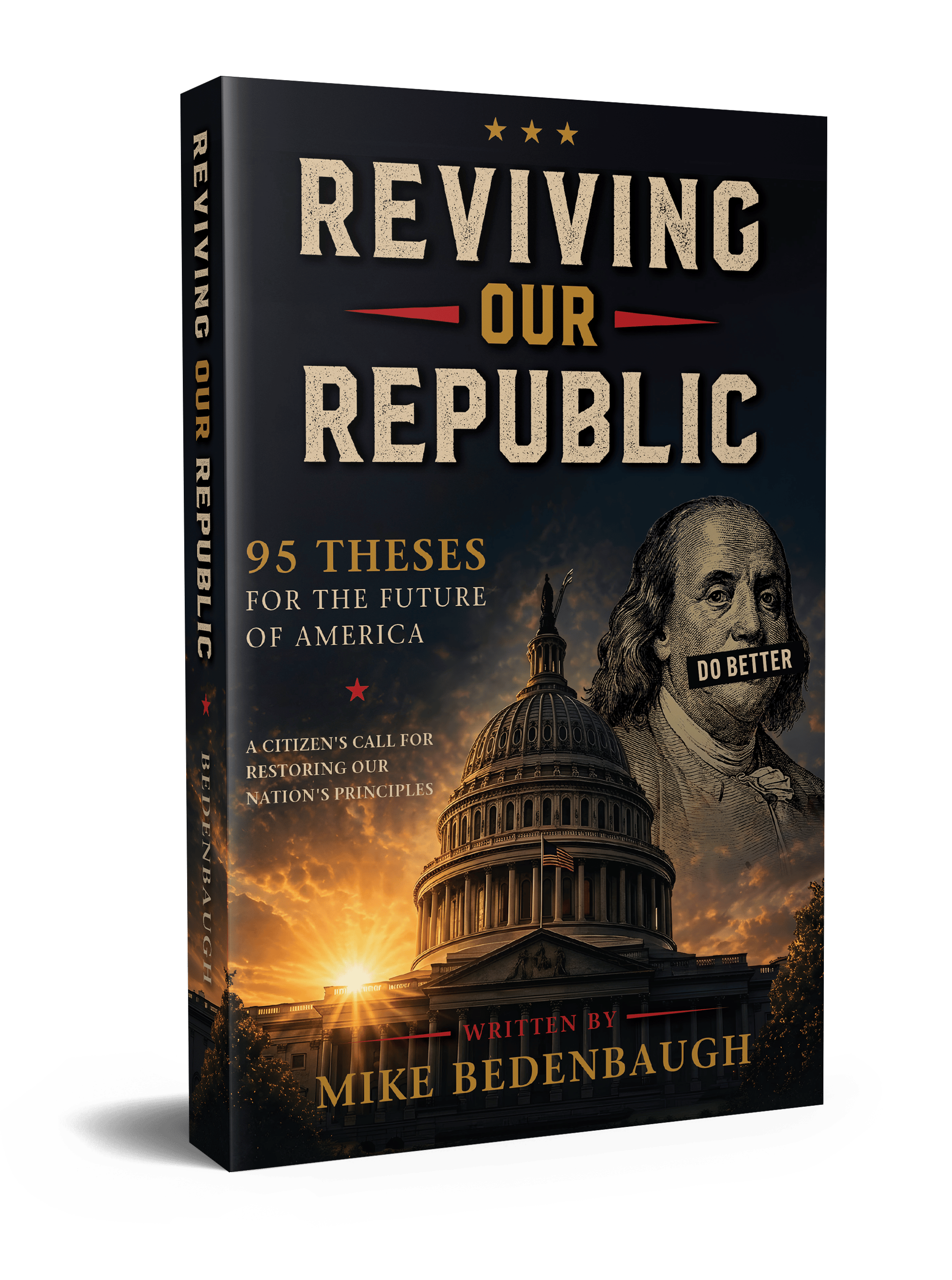
Every thesis on this page, with the argument behind it laid out at length — organized around the four warnings Washington issued in his Farewell Address. Delivered as a PDF you can read anywhere.
PDF Edition
$10
Included free with any annual membership
Secure checkout through Stripe. Sign in first — the PDF is delivered to your account.